REVIEW ARTICLE
Generation of virtual stains - can AI imitate chemistry?
1
Data, Analytics and Research Imaging Domain, Diagnostics Division (RIS), F.Hoffmann-La Roche Ltd, Basel, Switzerland
Submission date: 2026-05-15
Acceptance date: 2026-05-17
Publication date: 2026-06-25
Pol J Pathol 2026;77(2):203-208

KEYWORDS
TOPICS
ABSTRACT
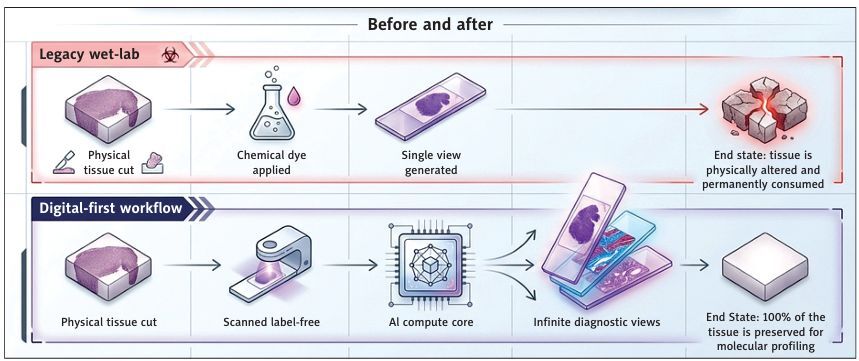
Histological staining is the foundation of anatomic pathology, yet traditional wet-lab workflows are slow, consume irreplaceable tissue, and are prone to artifactual variability. As precision oncology increasingly demands comprehensive molecular testing from limited biopsy samples, conserving tissue while delivering rapid, accurate diagnoses is an urgent clinical challenge. This review explores "virtual staining" – the digital generation of routine and special stains directly from label-free tissue scans or primary hematoxylin and eosin slides. We examine the shift toward advanced artificial intelligence models that preserve overall tissue architecture, the development of "pathology-aware" quality metrics, and clinical applications like instant multiplexed immunofluorescence and 3D intraoperative biopsies. Ultimately, virtual staining allows pathologists to simultaneously evaluate multiple diagnostic stains without depleting the physical block or waiting for laboratory processing. By adopting rigorous quality controls and optimizing for time-sensitive clinical workflows, this technology is poised to transition from a research novelty into a fundamental tool for preserving invaluable patient tissue and accelerating diagnostic turnaround times.
REFERENCES (29)
1.
Bancroft JD, Gamble M (eds.). Theory and practice of histological techniques. Elsevier Health Sciences 2008.
2.
Pillar N, Ozcan A. Virtual tissue staining in pathology using machine learning. Expert Rev Mol Diagn 2022; 22: 987-989.
3.
Abraham TM, Levenson R. Current landscape of advanced imaging tools for pathology diagnostics. Mod Pathol 2024; 37: 100443.
4.
Pillar N, Li Y, Zhang Y, Ozcan A. Virtual staining of nonfixed tissue histology. Mod Pathol 2024; 37: 100444.
5.
Hussain MA, Waris MA, Akram MU, Khan MJ, Asaf MZ, Javaid A, et al. VISGAB: Virtual staining-driven GAN benchmarking for optimizing skin tissue histology. Sci Rep 2025; 15: 42430.
6.
Ounissi M, Sarbout I, Hugot JP, Martinez-Vinson C, Berrebi D, Racoceanu D. Scalable, trustworthy generative model for virtual multi-staining from H&E whole slide images. PLoS Comput Biol 2025; 21: e1013516.
7.
Loo J, Robbins M, McNeil C, Yoshitake T, Santori C, Shan C, et al. Autofluorescence virtual staining system for H&E histology and multiplex immunofluorescence applied to immunooncology biomarkers in lung cancer. Cancer Res Commun 2025; 5: 54-65.
8.
Fanous MJ, Pillar N, Ozcan A. Digital staining facilitates biomedical microscopy. Front Bioinform 2023; 3: 1243663.
9.
PathAI. Transforming histology: how AI-powered virtual staining could unlock lab efficiency and redefine anatomic pathology workflows. PathAI Blog 2024. Available from: https:// www.pathai.com/blog/transforming-histology-how-ai-powered- virtual-staining-could-unlock-lab-efficiency-and-redefine- anatomic-pathology-workflows (accessed: 05.2026).
10.
Wang Q, Akram AR, Dorward DA, Talas S, Monks B, Thum C, et al. Deep learning-based virtual H&E staining from label-free autofluorescence lifetime images. NPJ Imaging 2024; 2: 17.
11.
Tweel JE, Ecclestone BR, Tummon Simmons JA, Boktor M, Fieguth P, Reza PH. Label-free whole slide virtual multi-staining using dual-excitation photon absorption remote sensing microscopy. NPJ Imaging 2026; 4: 22.
12.
De Haan K, Zhang Y, Zuckerman JE, Liu T, Sisk AE, Houwen MFPC, et al. Deep learning-based transformation of H&E stained tissues into special stains. Nat Commun 2021; 12: 4884.
13.
Falahkheirkhah K, Mukherjee SS, Gupta S, Herrera-Hernandez L, McCarthy MR, Jimenez RE, et al. Accelerating cancer histopathology workflows with chemical imaging and machine learning. Cancer Res Commun 2023; 3: 1875-1887.
14.
Tweel JE, Ecclestone BR, Boktor M, Tummon Simmons JA, Fieguth P, Reza PH. Virtual histology with photon absorption remote sensing using a cycle-consistent generative adversarial network with weakly registered pairs. arXiv 2023. Available from: https://doi.org/10.48550/arXiv....
15.
Ma J, Li W, Li J, Xu Z, Zhang Y, Wei B, et al. Generative AI for misalignment-resistant virtual staining to accelerate histopathology workflows. Nat Commun 2026; 17: 4494.
16.
Klöckner P, Teixeira J, Montezuma D, Oliveira J, Caspers J, Schierholz R, et al. H&E to IHC virtual staining methods in breast cancer: an overview and benchmarking. NPJ Digit Med 2025; 8: 384.
17.
Hussain MA, Waris MA, Akram MU, Khan MJ, Asaf MZ, Javaid A, et al. ViT-stain: vision transformer-driven virtual staining for skin histopathology via global contextual learning. PloS One 2026; 21: e0341311.
18.
Ecclestone BR, Tweel J, Li K, Gaouda H, Bell K, Dinakaran D, et al. Exploration of photoacoustic remote sensing virtual histology in skin malignancies. Proceeding SPIE 2023; PC12352: PC1235201.
19.
Bai B, Yang X, Li Y, Zhang Y, Pillar N, Ozcan A. Deep learningenabled virtual histological staining of biological samples. Light Sci Appl 2023; 12: 57.
20.
Al-Qudah R, Bala A, Almuhajri M, Zakaria K, Suen CY. A systematic review of machine learning for digital stain processing in pathology. Neurocomput 2026; 676: 133064.
21.
Ju W, Border S, Afsari F, Seth S, Rezapourdamanab S, Renteria R, et al. Validation of virtual trichrome stains for kidney fibrosis evaluation using dual-mode emission and transmission microscopy. medRxiv 2025.
22.
Balaha HM, Ali KM, Mahmoud A, Aboudessouki A, Azam MT, Giridharan GA, et al. From hematoxylin and eosin to masson’s trichrome: a comprehensive framework for virtual stain transformation in chronic liver disease diagnosis. Diagnostics (Basel) 2026; 16: 764.
23.
Zhang Y, Kang L, Yu W, Tsang VTC, Wong TTW. Threedimensional label-free histological imaging of whole organs by microtomy-assisted autofluorescence tomography. iScience 2022; 25: 103721.
24.
Gao G, Yan R, Song AH, Hsieh HC, Barner LAE, Wang F, et al. Deep-learning triage of 3D pathology datasets for comprehensive and efficient pathologist assessments. bioRxiv 2025.
25.
Wang Q, Tweel JED, Reza PH, Layton A. Pathology-guided virtual staining metric for evaluation and training. arXiv 2025.
26.
Huang L, Li Y, Pillar N, de Haan K, Zhang Y, Bai B, et al. A robust and scalable framework for hallucination detection in virtual tissue staining and digital pathology. Nat Biomed Eng 2025; 9: 2196-2214.
27.
Imran MT, Shafi I, Ahmad J, Butt MFU, Villar SG, Villena EG, et al. Virtual histopathology methods in medical imaging – a systematic review. BMC Med Imag 2024; 24: 318.
28.
Aldea M, Salto-Tellez M, Marra A, Umeton R, Stenzinger A, Koopman M, et al. ESMO basic requirements for AI-based biomarkers in oncology (EBAI). Ann Oncol 2026; 37: 414-430.
29.
Chauhan C, Gullapalli RR. Ethics of AI in pathology: current paradigms and emerging issues. Am J Pathol 2021; 191: 1673-1683.
Share
RELATED ARTICLE
| eISSN: | 2084-9869 |
| ISSN: | 1233-9687 |

We process personal data collected when visiting the website. The function of obtaining information about users and their behavior is carried out by voluntarily entered information in forms and saving cookies in end devices. Data, including cookies, are used to provide services, improve the user experience and to analyze the traffic in accordance with the Privacy policy. Data are also collected and processed by Google Analytics tool (more).
You can change cookies settings in your browser. Restricted use of cookies in the browser configuration may affect some functionalities of the website.
You can change cookies settings in your browser. Restricted use of cookies in the browser configuration may affect some functionalities of the website.