ORIGINAL ARTICLE
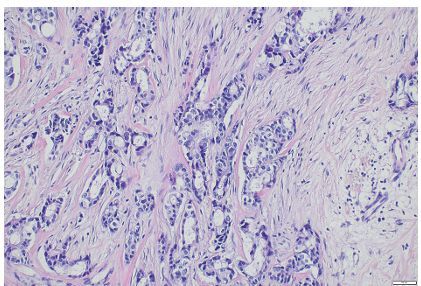
HER2-low breast cancer: a new diagnostic challenge for pathologists – insights from a single-center retrospective cohort
1
Department of Pathomorphology, Lazarski University, Warsaw, Poland
2
Pathomorphology Center, National Medical Institute of the Ministry of the Interior and Administration National Medical Institute, Warsaw, Poland
Submission date: 2026-07-06
Final revision date: 2026-08-10
Acceptance date: 2026-09-09
Publication date: 2026-10-28
Pol J Pathol 2026;77(3):296-303

KEYWORDS
breast cancerimmunohistochemistrypathologycore needle biopsytrastuzumabderuxtecanpredictive biomarkersHER2-lowHER2 reclassification
TOPICS
ABSTRACT
The introduction of antibody-drug conjugates, particularly trastuzumab deruxtecan, has fundamentally changed the clinical significance of low HER2 expression in breast cancer. Consequently, accurate discrimination between human epidermal growth factor receptor 2 (HER2) immunohistochemistry (IHC) score 0 and HER2-low (IHC 1+ or IHC 2+/ISH-negative) has become increasingly important in routine pathological practice.
This retrospective single-center observational study included consecutive patients diagnosed with invasive breast carcinoma between January 2023 and December 2024. Histopathological and immunohistochemical slides were re-evaluated according to current American Society of Clinical Oncology/College of American Pathologists recommendations. Cases were reclassified into HER2 0, HER2-low, and HER2-positive categories. Clinicopathological variables, including patient age, histological subtype, hormone receptor status, Ki-67 proliferation index, histological grade, and biological subtype, were analyzed using descriptive statistics.
Seventy-eight patients were analysed. Following reassessment, HER2-low tumors accounted for 33.3% (26/78) of all invasive breast cancers. Fifteen tumors initially classified as HER2 0 were reclassified as HER2-low. All HER2-low tumors were invasive carcinoma of no special type. Luminal B represented the predominant molecular subtype (65.4%), followed by triple-negative breast cancer (30.8%) and luminal A tumors (3.8%). Estrogen receptor expression was observed in 69.2% of HER2-low tumors, while progesterone receptor expression was detected in 61.5%.
Reclassification of HER2 expression substantially increased the number of patients classified as HER2-low, emphasizing the importance of precise immunohistochemical assessment, particularly in distinguishing IHC score 0 from IHC score 1+. These findings highlight the growing clinical relevance of standardized HER2 assessment in identifying patients who may become eligible for HER2-targeted antibody-drug conjugate therapy.
REFERENCES (29)
1.
Wojciechowska U, Didkowska J, Barańska K, Miklewska M, Michałek I, Olasek P, et al. Nowotwory złośliwe w Polsce w 2022 roku. Krajowy Rejestr Nowotworów. Narodowy Instytut Onkologii, Warszawa 2024.
3.
Siegel RL, Giaquinto AN, Jemal A. Cancer statistics, 2024. CA Cancer J Clin 2024; 74: 12-49.
4.
Olszewski W, Chmielik E, Kordek R. Standardy oceny makroskopowej materiału biopsyjnego i operacyjnego u chorych na nowotwory złośliwe. Zalecenia Polskiego Towarzystwa Patologów dotyczące zasad opracowania makroskopowego materiałów onkologicznych do badań patomorfologicznych. Sutek. Pol J Pathol 2015; 66: 30-35.
5.
Höller A, Nguyen-Sträuli BD, Frauchiger-Heuer H, Ring A. Diagnostic and prognostic biomarkers of luminal breast cancer: where are we now? Breast Cancer Targets Ther 2023; 15: 525-540.
6.
Wolff AC, Hammond MEH, Schwartz JN, Hagerty KL, Allred DC, Cote RJ, et al. American Society of Clinical Oncology/College of American Pathologists guideline recommendations for human epidermal growth factor receptor 2 testing in breast cancer. J Clin Oncol 2007; 25: 118-145.
7.
Wolff AC, Hammond MEH, Hicks DG, Dowsett M, McShane LM, Allison KH, et al. Recommendations for human epidermal growth factor receptor 2 testing in breast cancer: American Society of Clinical Oncology/College of American Pathologists clinical practice guideline update. J Clin Oncol 2013; 31: 3997-4013.
8.
Wolff AC, Hammond MEH, Allison KH, Harvey BE, Mangu PB, Bartlett JMS, et al. Human epidermal growth factor receptor 2 testing in breast cancer: American Society of Clinical Oncology/College of American Pathologists clinical practice guideline focused update. J Clin Oncol 2018; 36: 2105-2122.
9.
Wolff AC, Somerfield MR, Dowsett M, Hammond MEH, Hayes DF, McShane LM, et al. Human epidermal growth factor receptor 2 testing in breast cancer: American Society of Clinical Oncology-College of American Pathologists guideline update. Arch Pathol Lab Med 2023; 147: 993-1000.
10.
Marszałek A, Krzakowski M. Recommendations for evaluation of predictive marker HER2 in patients with invasive breast cancer. Oncol Clin Pract 2018; 14: 263-270.
11.
Marszałek A, Krzakowski M. Zalecenia dotyczące oceny czynnika predykcyjnego HER2 u chorych z rozpoznaniem inwazyjnego (naciekającego) raka piersi – aktualizacja na rok 2023. Stanowisko Konsultantów Krajowych w dziedzinie patomorfologii i onkologii klinicznej. Onkol Prakt Klin Edu 2024; 10: 302-307.
12.
Modi S, Jacot W, Yamashita T, Sohn J, Vidal M, Tokunaga E, et al. Trastuzumab deruxtecan in previously treated HER2-low advanced breast cancer. N Engl J Med 2022; 387: 9-20.
13.
Pogoda K, Jagiełło-Gruszfeld J, Nowecki Z. HER2-low – the new subtype of breast cancer? Oncol Clin Pract 2022; 18: 1-7.
14.
Shaaban AM, Kaur T, Provenzano E. HER2-low breast cancer: current knowledge and future directions. Medicina (Kaunas) 2025; 61: 644.
15.
Martin V, Valera V, Joffrey M, Banfi S, Mazzucchelli L. Implementation of the 2018 epidermal growth factor receptor 2 guideline by American Society of Clinical Oncology/College of American Pathologists will reduce false-positive tests. Arch Pathol Lab Med 2019; 143: 412-413.
16.
Ellis IO, Allison KH, Dang C, Gobbi H, Kulka J, Lakhani SR, et al. Invasive carcinoma of the breast histopathology reporting guide. 2nd ed. International Collaboration on Cancer Reporting, Sydney 2022.
17.
Allison KH, Krishnamurti U. Template for reporting results of biomarker testing of specimens from patients with carcinoma of the breast. College of American Pathologists 2025. Available from: https://www.cap.org/cancerprot... (accessed: 10.06.2026).
18.
Denkert C, Seither F, Schneeweiss A, Link T, Blohmer JU, Just M, et al. Clinical and molecular characteristics of HER2-low-positive breast cancer: pooled analysis of individual patient data from four prospective neoadjuvant clinical trials. Lancet Oncol 2021; 22: 1151-1161.
19.
Solarewicz J, Allison KH. Hormone receptor and HER2 testing in breast cancer: latest questions answered. Surg Pathol Clin 2025; 18: 735-750.
20.
Von Elm E, Altman DG, Egger M, Pocock SJ, Gøtzsche PC, Vandenbroucke JP. The strengthening the reporting of observational studies in epidemiology (STROBE) statement: guidelines for reporting observational studies. PLoS Medicine 2007; 4: e296.
21.
Press MF, Slamon DJ, Flom KJ, Park J, Zhou JY, Bernstein L. Evaluation of HER-2/neu gene amplification and overexpression: comparison of frequently used assay methods in a molecularly characterized cohort of breast cancer specimens. J Clin Oncol 2002; 20: 3095-3105.
22.
Ivanova M, Porta FM, D’Ercole M, Pescia C, Sajjadi E, Cursano G, et al. Standardized pathology report for HER2 testing in compliance with 2023 ASCO/CAP updates and 2023 ESMO consensus statements on HER2-low breast cancer. Virchows Arch 2024; 484: 3-14.
23.
Wang J, Long X, Tang M, Xiao X. HER2 and hormone receptor conversion after neoadjuvant therapy for breast cancer. Front Oncol 2025; 15: 1522460.
24.
Viale G, Basik M, Niikura N, Tokunaga E, Brucker S, Penault-Llorca F, et al. Retrospective study to estimate the prevalence and describe the clinicopathological characteristics, treatments received, and outcomes of HER2-low breast cancer. ESMO Open 2023; 8: 101615.
25.
Pous A, Bernat-Peguera A, López-Paradís A, Cirauqui B, Quiroga V, Teruel I, et al. Deciphering HER2-low breast cancer: insights from real-world data in early stage breast cancer. Ther Adv Med Oncol 2024; 16: 17588359241290720.
26.
Tsai YF, Huang CC, Hsu CY, Feng CJ, Lin YS, Chao TC, et al. Genomic alterations of tumors in HER2-low breast cancers. Int J Mol Sci 2024; 25: 1318.
27.
Chen M, Chen W, Liu D, Chen W, Shen K, Wu J, Zhu L. Prognostic values of clinical and molecular features in HER2-low breast cancer with hormonal receptor overexpression. Breast Cancer 2022; 29: 844-853.
28.
Schrijver WAME, Suijkerbuijk KPM, van Gils CH, van der Wall E, Moelans CB, van Diest PJ. Receptor conversion in distant breast cancer metastases: a systematic review and meta-analysis. J Natl Cancer Inst 2018; 110: 568-580.
29.
Shami J, Salgado R, Bardia A, Curigliano G, Hu X, Dent R, et al. Analytical and clinical validation of PATHWAY HER2 (4B5) assay for assessment of HER2-low/HER2-ultralow status and eligibility for trastuzumab deruxtecan in DESTINY-Breast06. ESMO Open 2025; 10: 105310.
Share
RELATED ARTICLE
| eISSN: | 2084-9869 |
| ISSN: | 1233-9687 |

We process personal data collected when visiting the website. The function of obtaining information about users and their behavior is carried out by voluntarily entered information in forms and saving cookies in end devices. Data, including cookies, are used to provide services, improve the user experience and to analyze the traffic in accordance with the Privacy policy. Data are also collected and processed by Google Analytics tool (more).
You can change cookies settings in your browser. Restricted use of cookies in the browser configuration may affect some functionalities of the website.
You can change cookies settings in your browser. Restricted use of cookies in the browser configuration may affect some functionalities of the website.