ORIGINAL ARTICLE
Associations between routine histopathological parameters and site-specific synchronous distant metastasis in colorectal adenocarcinoma
1
Department of Pathology, Faculty of Medicine, Kafkas University, Kars, Turkey
2
Department of Pathology, Faculty of Medicine, Manisa Celal Bayar University, Manisa, Turkey
Submission date: 2026-05-11
Final revision date: 2026-07-31
Acceptance date: 2026-08-26
Publication date: 2026-10-28
Pol J Pathol 2026;77(3):256-273

KEYWORDS
colorectal adenocarcinomasynchronous metastasissite-specific metastasishisto-pathologymismatch repair
TOPICS
ABSTRACT
Synchronous distant metastasis is a major determinant of prognosis in colorectal adenocarcinoma, but its associations with routine histopathological parameters at individual metastatic sites remain incompletely understood.
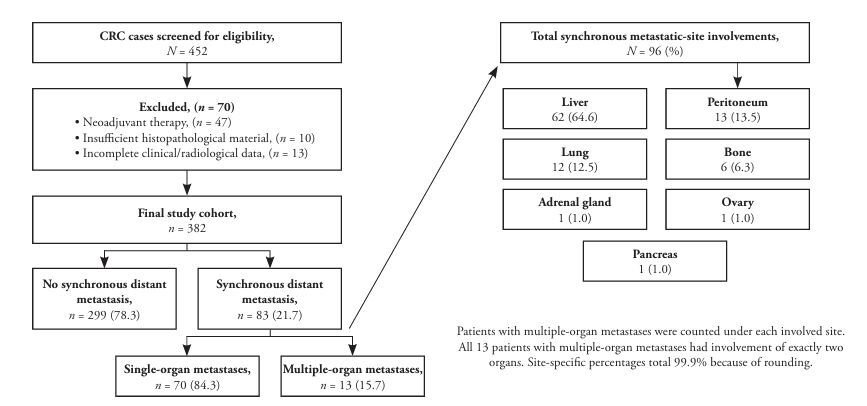
This retrospective study included 382 patients who underwent surgical resection for colorectal adenocarcinoma between 2006 and 2018. Clinicopathological parameters were evaluated in relation to synchronous distant metastasis overall and to liver, peritoneal, lung, and bone metastases using univariable analyses, exact tests where appropriate, and multivariable logistic regression. Synchronous distant metastasis was present in 83 patients (21.7%).
In two separate multivariable models, lymph node metastasis, positive proximal/distal resection margin, low peritumoral lymphocytic infiltration, and perineural invasion were associated with higher odds of synchronous distant metastasis, whereas deficient mismatch repair (dMMR) status was associated with lower odds. Liver metastasis was associated with lymph node metastasis and positive proximal/distal resection margin, whereas dMMR status was associated with lower odds. In restricted exploratory models, tumor deposits and non-conventional histological subtype were associated with peritoneal metastasis, and tumor perforation was associated with lung metastasis. Bone metastasis was too infrequent for multivariable analysis.
These organ-specific findings should be considered exploratory and require validation in larger
independent cohorts.
REFERENCES (33)
1.
Bray F, Laversanne M, Sung H, Ferlay J, Siegel RL, Soerjomataram I, et al. Global cancer statistics 2022: GLOBOCAN estimates of incidence and mortality worldwide for 36 cancers in 185 countries. CA Cancer J Clin 2024; 74: 229-263.
2.
Douaiher J, Ravipati A, Grams B, Chowdhury S, Alatise O, Are C. Colorectal cancer-global burden, trends, and geographical variations. J Surg Oncol 2017; 115: 619-630.
3.
Van der Geest LG, Lam-Boer J, Koopman M, Verhoef C, Elferink MA, de Wilt JH. Nationwide trends in incidence, treatment and survival of colorectal cancer patients with synchronous metastases. Clin Exp Metastasis 2015; 32: 457-465.
4.
Shin AE, Giancotti FG, Rustgi AK. Metastatic colorectal cancer: mechanisms and emerging therapeutics. Trends Pharmacol Sci 2023; 44: 222-236.
5.
Kopetz S, Chang GJ, Overman MJ, Eng C, Sargent DJ, Larson DW, et al. Improved survival in metastatic colorectal cancer is associated with adoption of hepatic resection and improved chemotherapy. J Clin Oncol 2009; 27: 3677-3683.
6.
Hugen N, van de Velde CJH, de Wilt JHW, Nagtegaal ID. Metastatic pattern in colorectal cancer is strongly influenced by histological subtype. Ann Oncol 2014; 25: 651-657.
7.
Lian L, Xu XF, Shen XM, Huang TA, Li XM, Han SG, et al. Pattern of distant metastases and predictive nomograms in colorectal mucinous adenocarcinoma: a SEER analysis. J Gastrointest Oncol 2021; 12: 2906-2918.
8.
Langley RR, Fidler IJ. The seed and soil hypothesis revisited: the role of tumor-stroma interactions in metastasis to different organs. Int J Cancer 2011; 128: 2527-2535.
9.
Fidler IJ. The pathogenesis of cancer metastasis: the “seed and soil” hypothesis revisited. Nat Rev Cancer 2003; 3: 453-458.
10.
Lim SB, Yu CS, Jang SJ, Kim TW, Kim JH, Kim JC. Prognostic significance of lymphovascular invasion in sporadic colorectal cancer. Dis Colon Rectum 2010; 53: 377-384.
11.
Chand M, Siddiqui MR, Swift I, Brown G. Systematic review of prognostic importance of extramural venous invasion in rectal cancer. World J Gastroenterol 2016; 22: 1721-1726.
12.
Knijn N, Mogk SC, Teerenstra S, Simmer F, Nagtegaal ID. Perineural invasion is a strong prognostic factor in colorectal cancer: a systematic review. Am J Surg Pathol 2016; 40: 103-112.
13.
Ryan É, Khaw YL, Creavin B, Geraghty R, Ryan EJ, Gibbons D, et al. Tumor budding and PDC grade are stage-independent predictors of clinical outcome in mismatch repair-deficient colorectal cancer. Am J Surg Pathol 2018; 42: 60-68.
14.
Ueno H, Kajiwara Y, Shimazaki H, Shinto E, Hashiguchi Y, Nakanishi K, et al. New criteria for histologic grading of colorectal cancer. Am J Surg Pathol 2012; 36: 193-201.
15.
Emile SH, Emile MH, Garoufalia Z, Dourado J, Wexner SD. Association between tumor deposits and liver and lung metastases at diagnosis of colorectal cancer: a SEER-based analysis. Surgery 2025; 178: 108904.
16.
Nagtegaal ID, Quirke P. What is the role for the circumferential margin in the modern treatment of rectal cancer? J Clin Oncol 2008; 26: 303-312.
17.
Boland CR, Goel A. Microsatellite instability in colorectal cancer. Gastroenterology 2010; 138: 2073-87.e3.
18.
Llosa NJ, Cruise M, Tam A, Wicks EC, Hechenbleikner EM, Taube JM, et al. The vigorous immune microenvironment of microsatellite instable colon cancer is balanced by multiple counterinhibitory checkpoints. Cancer Discov 2015; 5: 43-51.
19.
Ogino S, Nosho K, Irahara N, Meyerhardt JA, Baba Y, Shima K, et al. Lymphocytic reaction to colorectal cancer is associated with longer survival, independent of lymph node count, microsatellite instability, and CpG island methylator phenotype. Clin Cancer Res 2009; 15: 6412-6420.
20.
He R, Huang S, Lu J, Su L, Gao X, Chi H. Unveiling the immune symphony: decoding colorectal cancer metastasis through immune interactions. Front Immunol 2024; 15: 1362709.
21.
Li Q, Wang G, Luo J, Li B, Chen W. Clinicopathological factors associated with synchronous distant metastasis and prognosis of stage T1 colorectal cancer patients. Sci Rep 2021; 11: 8722.
22.
Lugli A, Kirsch R, Ajioka Y, Bosman F, Cathomas G, Dawson H, et al. Recommendations for reporting tumor budding in colorectal cancer based on the International Tumor Budding Consensus Conference (ITBCC) 2016. Mod Pathol 2017; 30: 1299-1311.
23.
Al-Sukhni E, Attwood K, Gabriel EM, LeVea CM, Kanehira K, Nurkin SJ. Lymphovascular and perineural invasion are associated with poor prognostic features and outcomes in colorectal cancer: a retrospective cohort study. Int J Surg 2017; 37: 42-49.
24.
Buckowitz A, Knaebel HP, Benner A, Bläker H, Gebert J, Kienle P, et al. Microsatellite instability in colorectal cancer is associated with local lymphocyte infiltration and low frequency of distant metastases. Br J Cancer 2005; 92: 1746-1753.
25.
Malesci A, Laghi L, Bianchi P, Delconte G, Randolph A, Torri V, et al. Reduced likelihood of metastases in patients with microsatellite-unstable colorectal cancer. Clin Cancer Res 2007; 13: 3831-3839.
26.
Benatti P, Gafà R, Barana D, Marino M, Scarselli A, Pedroni M, et al. Microsatellite instability and colorectal cancer prognosis. Clin Cancer Res 2005; 11: 8332-8340.
27.
Kang S, Na Y, Joung SY, Lee SI, Oh SC, Min BW. The significance of microsatellite instability in colorectal cancer after controlling for clinicopathological factors. Medicine (Baltimore) 2018; 97: e0019.
28.
Bendari A, Ucar E, Bendari A, Hammoud H, Kiran FNU, Al-Refai R, et al. A high number of tumor deposits (≥ 4) is an isolated predictor of local recurrence and distant metastasis in non-metastatic colorectal cancer:a single center study. Surg Exp Pathol 2024; 7: 30.
29.
Reggiani Bonetti L, Barresi V, Bettelli S, Domati F, Palmiere C. Poorly differentiated clusters (PDC) in colorectal cancer: what is and ought to be known. Diagn Pathol 2016; 11: 31.
30.
Konishi T, Shimada Y, Lee LH, Cavalcanti MS, Hsu M, Smith JJ, et al. Poorly differentiated clusters predict colon cancer recurrence: an in-depth comparative analysis of invasive-front prognostic markers. Am J Surg Pathol 2018; 42: 705-714.
31.
Lin Q, Wei Y, Ren L, Zhong Y, Qin C, Zheng P, et al. Tumor deposit is a poor prognostic indicator in patients who underwent simultaneous resection for synchronous colorectal liver metastases. Onco Targets Ther 2015; 8: 233-240.
32.
Zamaray B, van Velzen RA, Snaebjornsson P, Consten ECJ, Tanis PJ, van Westreenen HL. Outcomes of patients with perforated colon cancer: a systematic review. Eur J Surg Oncol 2023; 49: 1-8.
33.
Takagi M, Kim S, Suzuki M, Takayama T, Asano H. Factors associated with postoperative recurrence in perforated colorectal cancer: unraveling the high recurrence rate of perforated colorectal cancer. World J Surg Oncol 2025; 23: 139.
Share
RELATED ARTICLE
| eISSN: | 2084-9869 |
| ISSN: | 1233-9687 |

We process personal data collected when visiting the website. The function of obtaining information about users and their behavior is carried out by voluntarily entered information in forms and saving cookies in end devices. Data, including cookies, are used to provide services, improve the user experience and to analyze the traffic in accordance with the Privacy policy. Data are also collected and processed by Google Analytics tool (more).
You can change cookies settings in your browser. Restricted use of cookies in the browser configuration may affect some functionalities of the website.
You can change cookies settings in your browser. Restricted use of cookies in the browser configuration may affect some functionalities of the website.